Sorting their belongings
There is no deadline on a closet. Why clearing a home is so much harder than it looks, how to start when you are ready, and what to do when a landlord sets the clock.
By Everheld · · 9 min read
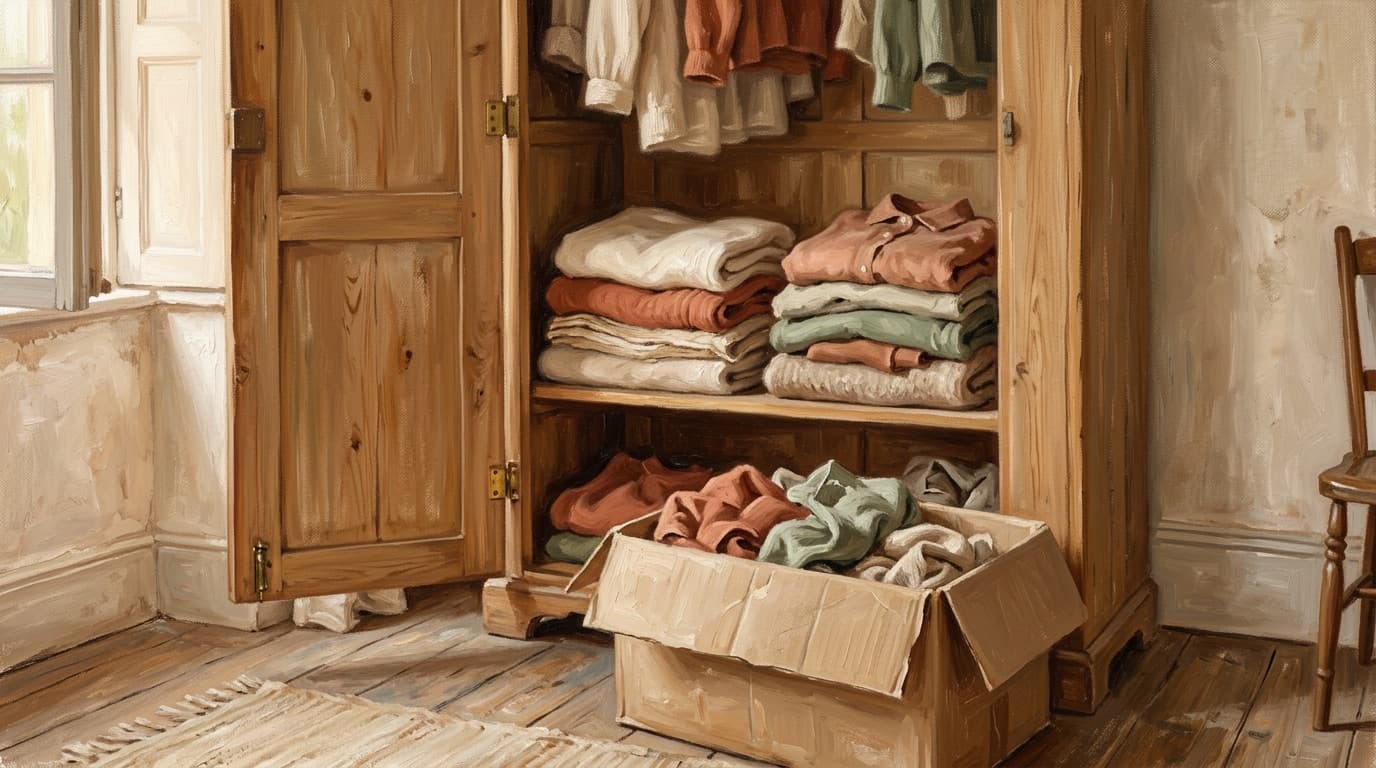
At some point, someone will suggest it is time to do something about the clothes. They will mean well. They may even be right, eventually. But they are almost certainly wrong about when.
The things a person owned are not simply objects. They are the shape of a life — the coat with their weight still in the shoulders, the handwriting on a grocery list, the half-used bottle of shampoo. Deciding what happens to all of it is one of the heaviest tasks grief hands you, and it is routinely underestimated by everyone who is not the one doing it.
There is no deadline
Nothing in the law, in medicine, or in grief requires you to clear a home on any timetable. There is no evidence that doing it quickly helps, and none that leaving a room untouched for a year does harm. People who wait are not stuck, and people who start immediately are not cold.
The urgency almost always comes from outside you: a landlord, a sale, a family member who cannot bear to see the coat on the hook, a well-meaning friend with a car and a free Saturday.
The friend and the family member can be told to wait. Try:
- "I am not ready. I will ask for your help when I am."
- "We are not doing that yet."
- "You can help me with the kitchen. We are not touching the bedroom."
You do not owe anyone a date. If someone keeps pushing, it is worth noticing that the discomfort they are trying to resolve is usually their own.
Why it is so much harder than it looks
Two things are happening at once, and both are real.
Objects hold them. Scent especially: smell routes almost directly into the brain regions that handle emotion and memory, with less filtering than sight or sound. This is why a coat can flatten you in a way a photograph does not. Touch and habit do it too — the worn spot on a handle, the way a sweater is folded. Handling their things is a form of contact, and letting them go can feel, physically, like a second loss. It is not irrational. It is how memory works.
And every object is a decision. Clearing a house is not physical labor, it is a few thousand consecutive judgment calls — keep or not, who gets it, precious or junk — each carrying an emotional charge, made at exactly the moment grief has impaired your ability to decide anything at all. Two hours of it can leave you more exhausted than a full day of anything else.
You are not slow. You are doing the hardest kind of work there is: deciding, over and over, what you are willing to be without.
If and when you want to start
Start with the least loaded thing in the house
Do not begin with the closet, and never with the bedside table. Begin where the emotional charge is lowest, so you can find out how this feels before it costs you anything. Roughly, in order:
- Consumables and obvious rubbish. Expired food, old medications (most pharmacies take them back), cleaning products.
- Duplicates and utilities. Six screwdrivers, four spatulas, the drawer of dead cables.
- Furniture that was never really theirs. The spare chair. The filing cabinet.
- Bulk clothing — the ordinary, unremarkable items. Not the coat. Not the shirt they wore last.
- Books, records, tools, collections.
- Papers. Slowly: money, letters, and photographs hide in them.
- The loaded things. Their bedside table. Their handwriting. The clothes still holding their shape. Last, if ever.
Set a timer, and stop when it goes off even if you feel fine. People routinely overshoot on a good day and then cannot go near the room for a month.
The three-box method, and why it usually collapses
You will be told to use three boxes: keep, donate, throw away. It is a fine system for a house move, and it fails here for one reason: it has nowhere to put "I don't know."
Grief stalls on the first ambiguous object — a single glove, a birthday card, a book you have never seen — and with no box for uncertainty, the whole afternoon stops. Worse, three boxes force an irreversible answer on the spot, on a day when your judgment is not at its best.
So use four, and make the fourth one generous:
- Keep
- Let go — donate, sell, or discard
- Ask someone — decisions that are not yours alone
- Not yet — anything at all, with no limit and no shame
The "not yet" box gets sealed, labelled, and put out of sight. Some people open it in a year and empty half of it in an hour. Some never open it, and that is a fine outcome too — that box costs you almost nothing. There is more on why later feels different in how grief changes over time.
Keeping: too much, too little, and the smell
The two regrets are symmetrical, and both are common.
Purging too fast usually happens in the first weeks — sometimes to feel like something is under control, sometimes because a helper filled a car with trash bags while you were not looking. People do grieve those things. Once a thing is gone it is gone.
Keeping everything has its own weight: a house that becomes a museum you are not allowed to live in, or a storage unit you pay for indefinitely and cannot bring yourself to open.
The middle is narrower and kinder: keep the fewest things that carry the most. And be careful what "the most" means, because it is rarely the formal keepsake. The good china carries less than the mug they used every single morning. A framed certificate carries less than a shopping list in their handwriting. Keep the ordinary thing.
On scent: do not wash it. If you want to keep a garment for its smell, put it, unwashed, in a bag with the air pressed out, and open it rarely. The smell does fade eventually, and when it does, it is its own small loss. Knowing that in advance seems to help.
Photograph it before you let it go
Before something leaves, photograph it — properly, in good light, the way you would photograph something you were selling. The photograph carries a surprising amount of what the object carried, and it takes up no room.
Photograph the rooms, too, before you disturb them: the shelf as they arranged it, the coats on the hook, the pens in the exact chaos they left them in. People rarely think to do this, and very often wish they had.
Some things can also be changed rather than lost. Shirts become a quilt. A dress becomes a cushion cover. A watch nobody will ever wear becomes something someone will.
Things nobody wants
Some of it, nobody wants. Not the family, not the charity shop, not anyone. This is a demoralizing discovery, and it is not a reflection on the person.
| The thing | Where it can actually go | Worth knowing |
|---|---|---|
| Ordinary clothing | Charity shops, shelters, clothing banks | Ask first — many are overwhelmed and turn things away |
| Worn-out clothing and linens | Textile recycling programs | Damaged fabric can be recycled; it need not go to landfill |
| Work clothing and suits | Job-readiness and interview-clothing programs | Often genuinely needed |
| Tools, hardware, building materials | Habitat ReStore and similar reuse centres | Usually free pickup for larger loads |
| Medical equipment, walkers, wheelchairs | Local medical loan closets, some churches | Frequently in short supply |
| Eyeglasses | Lions Club collection boxes | Prescription glasses are reused |
| Books | Libraries, little free libraries, resale-for-charity programs | Most charity shops will not take large lots |
| Brown furniture, china, collections | Estate sale company, auction, consignment | The market for these is close to nothing, and that is not your fault |
| Everything left | Clear-out service, dumpster | It is allowed. It really is |
That last line is the one that needs saying. It is allowed to throw something away. Making an object's disposal into a moral test is a burden nobody who loved you would want you carrying.
When a landlord sets the clock
This is the cruellest version: a lease ending, a sale closing, and a person nowhere near ready. Two moves, in order.
First, buy time. Ask, in writing, for an extension, and offer to pay another month's rent. Landlords say yes more often than people expect, and a month of rent is almost always cheaper than a decision you cannot undo. It is not a favor to be ashamed of asking for.
If the answer is no: do not sort. Pack.
Do not make thousands of irreversible emotional decisions against a clock. Instead:
- Photograph every room, exactly as it is, before you touch anything.
- Put everything in boxes, labelled by room, not by contents. Do not open, evaluate, or agonize.
- Check pockets, books, tins, envelopes, and the freezer — money, letters, and photographs hide in all of them.
- Move it into storage, a garage, or a spare room.
- Sort it in six months, when you are the one holding the clock.
Storage for a few months costs a fraction of what it costs to give away, in one bad week, the only thing you wanted to keep. And if you end up paying for it longer than you meant to, that is fine as well. Later is the point.
Go slowly, take the smallest room, stop early, and let the "not yet" box be as full as it needs to be. If any of this takes you somewhere frightening, you can call or text 988 in the US for the Suicide & Crisis Lifeline, or text HOME to 741741 for the Crisis Text Line; internationally, findahelpline.com (opens in a new tab) will find you a line.
Questions people ask
How long should I wait before sorting their things?
As long as you want. There is no medical, legal, or psychological deadline, and no evidence that clearing a home quickly helps anyone grieve. Some people need to start in the first week to feel like they can breathe. Others leave a room untouched for a year and then find they can do it in a weekend. Both are entirely normal.
How do I get people to stop pressuring me to clear out the house?
Say a version of this: "I am not ready, and I will ask for your help when I am." You do not owe an explanation or a date. Pressure to clear things is usually about the other person's discomfort with the room as it is — it is rarely really about you. If the pressure continues, you are allowed to limit their access to the house.
Why is going through their clothes so much harder than I expected?
Objects hold memory in a way that is unusually direct. Scent especially — smell routes almost straight into the parts of the brain that handle emotion and memory, which is why a coat can undo you faster than a photograph. On top of that, every single item is a decision, and grief measurably impairs decision-making. You are not being weak. You are doing something genuinely hard.
Should I keep their clothes for the smell?
Many people do, and it is not strange. Do not wash the item. Sealing a shirt or a pillowcase in a bag with the air pressed out slows the fading, though scent does fade eventually no matter what — and that second loss is real, and worth being warned about. Keeping one garment unworn and unwashed, and opening the bag rarely, is a common and gentle compromise.
What do I do with things nobody in the family wants?
More than you would think. Tools go to Habitat ReStore, work clothing to job programs, medical equipment to local loan closets, books to libraries or resale programs, eyeglasses to Lions Club collection points, and worn-out textiles to fabric recycling rather than landfill. For a full household, an estate sale company or a clear-out service can handle what is left. It is also allowed for something to simply be thrown away.
The landlord has given me a deadline. What do I do?
Ask in writing for an extension, and offer to pay another month's rent — a month of rent is almost always cheaper than a decision you cannot undo. If the answer is no, do not sort. Pack. Put everything in labelled boxes into a storage unit or a friend's garage, photograph each room before you disturb it, and make the real decisions months from now, when you are the one setting the pace.